
Food & Beverage Industry Insights
Discover market intelligence, commodity trends, ingredient sourcing news, and expert technical guidance from American International Foods, Inc.
Market News & Commodity Trends
Stay ahead of price fluctuations, supply chain updates, and raw material availability across key food manufacturing sectors.
Expert Ingredient Solutions
Explore articles on organic, non-GMO, gluten-free, and conventional ingredient innovations for modern processors.
What Are the Top Meat Processing Ingredients?
Table of Contents
- What Meat Processing Ingredients Are and Why They Are Used
- The Main Ingredient Categories in Processed Meat
- How Each Ingredient Affects Texture, Flavor, and Preservation
- How Meat Processors Select Ingredients for Different Products
- Food Safety and Labeling Rules for Meat Processing Ingredients
- FAQS
- Conclusion
- Related Posts
Meat Processing Ingredients shape how products hold water, develop texture, retain color, and stay consistent from batch to batch. The FAO’s Food Outlook, published in June 2024, projected global meat production at about 365 million tonnes that year. More production means more pressure to manage quality carefully. Still, volume alone does not explain what makes a successful formulation.
Salt supports flavor and protein extraction. Phosphates can improve moisture retention, while curing ingredients and antioxidants serve specific technical roles. Their effects depend on the product, process, and measured dose. A useful reminder from Iowa State meat scientist Joe Cordray’s sausage-making guidance is to keep meat cold during grinding and mixing. The detail matters. Warm meat can smear during grinding and compromise texture.
The USDA Food Safety and Inspection Service’s Appendix A provides guidance for validating thermal processes in certain meat and poultry products. It underscores an important distinction: ingredients support product quality, but they do not replace validated food-safety controls. This guide examines common ingredient groups, their functions, and practical selection factors, including labeling, formulation, and consistency. Some choices seem obvious on paper. Production is messier, and a small change can affect several product qualities at once. That trade-off deserves close attention.
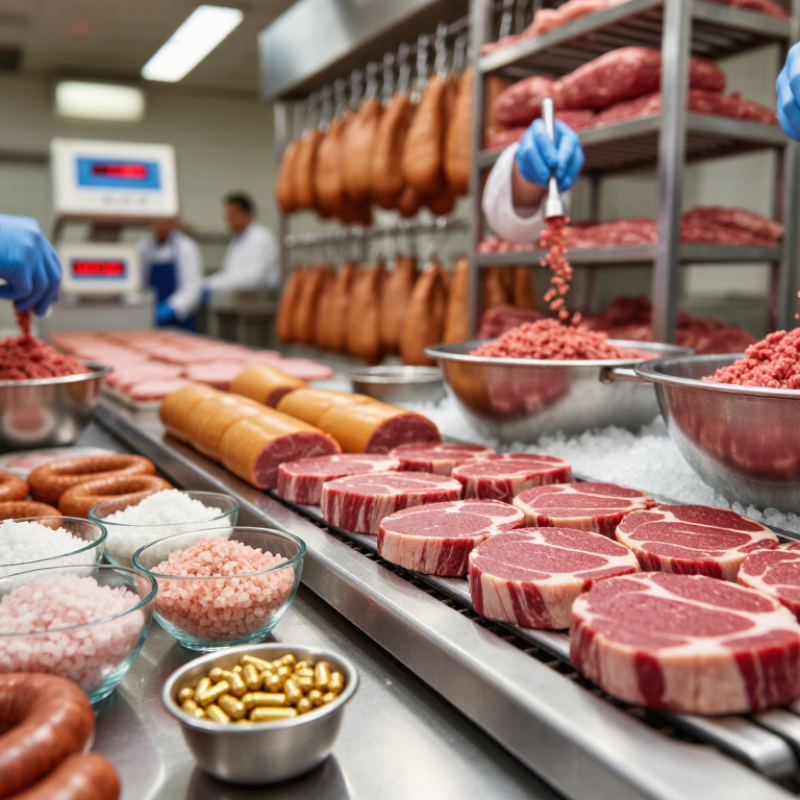
What Meat Processing Ingredients Are and Why They Are Used
Meat processing ingredients are functional tools, not merely flavor additions. Salt seasons meat and helps extract muscle proteins that bind water and hold slices together. In a sausage mixture, that binding can mean fewer crumbly edges after cooking. Phosphates may improve moisture retention, while spices, sugars, and antioxidants shape flavor and slow quality loss. Curing ingredients contribute characteristic color and flavor; their use requires precise formulation and process control. Small changes matter.
The scale makes these choices consequential. FAO’s Food Outlook, published in June 2024, estimated global meat production at about 364 million tonnes in 2023. At that volume, ingredient performance affects consistency, yield, and storage across many products. USDA’s Food Safety and Inspection Service publishes separate guidance for validated cooking processes and safe handling, underscoring that ingredients cannot replace temperature control. Salt can help with texture, but too much may make a product harsh. And a formulation that works in a test batch may behave differently on a busy production line. It deserves another check. Sources: FAO Food Outlook, June 2024; USDA FSIS, Cooking Guideline for Meat and Poultry Products.
The Main Ingredient Categories in Processed Meat
Processed meat ingredients usually fall into several functional groups: salt, curing agents, binders, water, and seasonings. Salt helps develop flavor and supports water retention, while ingredients such as starches or proteins can improve binding in sausages and formed products. In a mixing bowl, these functions become tangible: salt dissolves into the meat, and binders help keep fat and moisture from separating during cooking. Small amounts matter.
Curing agents, including nitrite, help produce characteristic color and flavor and inhibit certain harmful bacteria when used correctly. The USDA Food Safety and Inspection Service sets maximum ingoing nitrite levels of 120 parts per million for bacon and 200 parts per million for many other cured meat products (9 CFR 424.21(c)). These are processing limits, not targets for every recipe. Formulations vary by product, and accurate weighing is essential.
Phosphates can support moisture retention and texture, while spices, herbs, and smoke flavorings shape a product’s sensory profile. Water or ice also helps control temperature during mixing and contributes to the final texture. Still, ingredient labels do not always explain how well a product performs in a real process. A formulation that works in one grinder or casing may behave differently elsewhere. That deserves more attention. Good ingredient selection depends on product goals, process conditions, and careful testing—not simply adding more functional ingredients.
What Are the Top Meat Processing Ingredients? — The Main Ingredient Categories in Processed Meat
| Ingredient Category | Common Examples | Main Function | Typical Applications | Indicative Use Level |
|---|---|---|---|---|
| Meat and poultry | Beef, pork, chicken, turkey | Provides the principal protein, flavor, and structure of the finished product. | Sausages, deli meats, patties, formed products | Typically the largest part of the formulation; varies by product. |
| Water and ice | Potable water, flaked ice | Supports mixing and temperature control; contributes to juiciness and yield. | Emulsified sausages, cooked ham, frankfurters | Often about 5–30% in products that include added water; formulation-dependent. |
| Salt | Sodium chloride | Provides seasoning, helps extract salt-soluble meat proteins, and contributes to texture and preservation. | Sausages, cured meats, bacon, deli meats | Commonly around 1.5–3% of the formulation, depending on product and taste target. |
| Curing agents | Sodium nitrite; nitrate in certain traditional curing processes | Helps develop cured color and characteristic flavor, and inhibits certain microorganisms when used correctly. | Cured ham, bacon, hot dogs, some fermented sausages | Used at low, regulated levels; permitted amounts and rules vary by product and jurisdiction. |
| Phosphates | Food-grade sodium or potassium phosphate blends | Can improve water retention, bind, and texture in products where permitted. | Cooked ham, poultry products, emulsified sausages | Usually a small fraction of the formulation; maximum levels are regulated in many markets. |
| Sugars and sweeteners | Dextrose, sucrose, brown sugar | Balance salt and spice; sugars can also support fermentation in some sausage styles. | Dry or fermented sausages, cured ham, bacon | Often about 0.2–2%, depending on style and desired flavor. |
| Spices and flavorings | Black pepper, paprika, garlic, coriander, chili | Provide characteristic aroma, flavor, and sometimes color. | Sausages, seasoned meats, marinated products | Varies widely, commonly from trace amounts to a few percent. |
| Binders and extenders | Starches, cereal ingredients, soy or milk proteins where used | Can support binding, texture, moisture retention, or product yield. | Cooked sausages, meat loaves, formed meat products | Product- and ingredient-dependent; labeling and permitted levels vary. |
| Antioxidants and color stabilizers | Ascorbate or erythorbate; tocopherols in some applications | Help limit oxidation or support color stability, depending on the ingredient and process. | Cured meats, sausages, sliced ready-to-eat meats | Typically used at low levels in accordance with applicable food regulations. |
| Casings and coatings | Natural casings; edible collagen or cellulose casings | Shape and contain the product during filling, cooking, or storage. | Fresh, cooked, smoked, and dry sausages | Applied as a product covering rather than measured as a percentage of the meat mix. |
Note: Use levels are indicative industry ranges, not universal standards. Actual formulations depend on product type, processing method, labeling requirements, and local food regulations.
How Each Ingredient Affects Texture, Flavor, and Preservation
Salt does more than season meat. It dissolves muscle proteins, helping them bind water and form a springy sausage or sliceable ham. Too much, though, can make flavor harsh. The USDA Dietary Guidelines for Americans, 2020–2025, recommend adults limit sodium to under 2,300 milligrams daily. That benchmark matters when formulators balance salt’s texture benefits against the sodium in each serving.
Phosphates improve water retention and reduce cooking loss, so a patty stays less dry in the pan. Their effect depends on the meat and process; more is not automatically better. Nitrite helps create cured color and flavor, and it inhibits certain dangerous bacteria when used within regulated limits. The USDA FSIS Processing Inspectors’ Calculations Handbook gives product-specific calculations for nitrite and other curing agents, underscoring why recipes need precise weighing. Small errors matter.
Sugar can soften salt’s sharp edge and support browning, while spices add aroma that survives cooking. Ascorbate is often paired with nitrite to support curing reactions and color stability. These ingredients interact, not simply add up. A practical test is to compare cooked samples side by side: note slice firmness, pan moisture, aroma, and color after cooling. A little less salt may improve the label, but it can also weaken texture. That trade-off deserves testing.
What Are the Top Meat Processing Ingredients?
How common ingredients affect texture, flavor, and preservation
Ratings are qualitative comparisons (1 = low, 5 = high), not laboratory measurements; actual effects depend on the product and formulation. Salt supports flavor, protein extraction, and preservation. Phosphates improve water binding and texture, while curing nitrite contributes cured-meat color and flavor and helps control certain pathogens when used within regulated limits. Ingredients do not replace safe handling, cooking, or refrigeration.
How Meat Processors Select Ingredients for Different Products
What Are the Top Meat Processing Ingredients?
Meat processors rarely choose ingredients from a universal “top” list. They begin with the product’s texture, flavor, cooking method, and shelf-life goals. Fresh sausage needs a different balance from cooked ham or a formed patty.
Salt seasons the meat and helps release proteins that bind the mixture. Water or ice can support mixing and juiciness, but excess moisture may weaken the finished texture. Phosphates can improve water retention in some cooked products, while starches and other binders may help a sliced loaf hold its shape.
Small details matter. A firmer bite can also feel less tender.
Processors weigh more than function. Ingredient amounts must suit the meat, equipment, and production conditions. A seasoning blend that tastes balanced in a small test may seem too strong after cooking.
They run pilot batches, measure yield, and check texture after chilling and slicing. Real production can be less tidy than a spreadsheet suggests. A minor change in meat temperature or mixing time may affect how well the ingredients perform.
Not always. Teams may need to adjust and test again before a formula behaves consistently. They also review ingredient declarations, allergen risks, and applicable local requirements before production.
Food Safety and Labeling Rules for Meat Processing Ingredients
What Are the Top Meat Processing Ingredients?
Food Safety and Labeling Rules for Meat Processing Ingredients
Salt, seasonings, curing agents, phosphates, and binders can each affect a product’s flavor, texture, or shelf life. Their safe use depends on the ingredient, its purpose, and the rules in the market where the food is sold. Keep current supplier specifications and check that each ingredient is suitable for its intended use. Details matter.
Label requirements vary by location and product type. Ingredient names, allergen declarations, and the order of ingredients may all need careful review. A small change to a seasoning blend can alter the label, so compare the final recipe with the packaging before production. This part is easy to underestimate. Keep batch records that connect ingredient lots to finished products, and monitor storage temperatures, sanitation, and mixing steps as part of routine food safety controls. When a rule is unclear, consult the relevant regulator or a qualified food-labeling professional rather than guessing.
Tips: Use a controlled recipe sheet. Check incoming packaging against the purchase specification. Recheck labels after recipe changes. A quick visual check helps, but it is not enough.
FAQS
Common groups include salt, curing agents, binders, water, and seasonings. Each has a different role. Small amounts matter.
Salt helps meat proteins bind water, which can create a springy sausage or a sliceable ham. Too much may taste harsh. It also adds sodium, so texture and nutrition need balancing.
Binders help hold fat and moisture together during cooking. Without a suitable balance, a product may separate or feel less cohesive.
Curing agents can contribute characteristic color and flavor. When used within applicable limits, they also help inhibit certain harmful bacteria. Accurate formulation and weighing are important.
Phosphates can help retain moisture and improve texture. They may reduce cooking loss, but the effect depends on the meat and process. More is not automatically better.
Water or ice helps control temperature during mixing and influences the final texture. The result can vary with the equipment and formulation.
Sugar can soften salt’s sharpness and support browning. Spices and herbs add aromas that can remain noticeable after cooking. The balance takes testing.
Compare cooked samples side by side. Check firmness, moisture in the pan, aroma, and color after cooling. It is not a perfect test, but it reveals useful differences.
Ingredients can behave differently across grinders, casings, and processing conditions. A formula that works in one setup may not work as well elsewhere. That deserves a closer look.
Conclusion
Meat Processing Ingredients are the functional components added to meat products to help achieve consistent quality, appealing flavor, suitable texture, and reliable shelf life. Common categories include seasonings and flavorings, salt, curing ingredients, binders, and ingredients that help retain moisture or stabilize a product. Each serves a different purpose: seasonings shape taste, while functional ingredients can influence firmness, juiciness, color, and preservation.
Processors choose ingredients according to the product they are making, its desired characteristics, and the production method. A sausage, deli meat, and formed meat product may therefore require different combinations and proportions. Ingredient selection also depends on safe handling and clear labeling. Following applicable food safety requirements and accurately disclosing ingredients helps protect consumers and makes product information easier to understand.

Blog Tags: